
How to Play Rummy — Rules, Sequences & Sets Explained
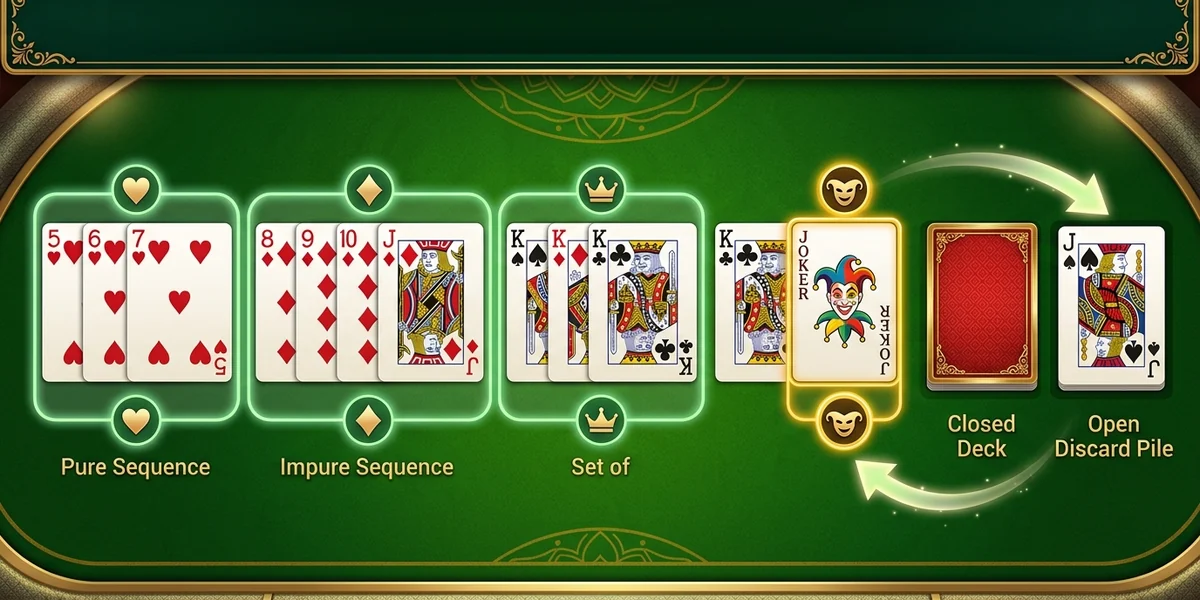
If you have searched how to play rummy, this is the plain-English guide. Indian rummy (also called 13-card rummy) looks complicated the first time you see a busy app table, but the core idea is simple: sort the 13 cards in your hand into valid groups faster than your opponents. Below we cover what rummy is, how many cards are used, the rules that decide a win, and the one mistake that trips up almost every beginner.
What is rummy?
Rummy is a card game where each player is dealt a hand of cards and races to arrange them into valid sequences and sets. The moment all your cards form valid groups, you "declare" and win the round. It is classed in India as a game of skill — memory, probability and smart discarding decide the outcome over time, not pure luck — which is why it is legal to play for money in most (not all) Indian states.
How many cards are in rummy?
Standard 13-card Indian rummy is played with two decks of 52 cards plus 2 printed jokers (110 cards total) when 2–6 players sit at a table. Each player is dealt 13 cards. The remaining cards form the closed deck (the draw pile); the first card is flipped to start the open discard pile, and one random card is chosen as the wild joker for that round.
The goal: sequences and sets
To win you must arrange all 13 cards into groups, and your declaration is only valid if it contains at least two sequences, one of which must be a pure sequence. Here is what those mean:
- Pure sequence — three or more cards of the same suit in consecutive order, with no joker (e.g. 5♥ 6♥ 7♥). You must have at least one.
- Impure sequence — a run that uses a joker to fill a gap (e.g. 8♦ 9♦ 🃏 J♦).
- Set — three or four cards of the same rank but different suits (e.g. K♠ K♦ K♣). Jokers can substitute a missing card.
The rule everyone forgets: without a pure sequence, your hand is invalid — even if the other 10 cards are perfect. Make the pure sequence your first priority every game.
How a turn works
On your turn you do two things: draw one card (from the closed deck or the open discard pile), then discard one card you do not need. You are always holding 13 cards between turns. Play continues clockwise until one player forms valid groups with all 13 cards and declares.
Card values (if you lose)
When someone declares, everyone else scores penalty points for the cards not yet grouped — lower is better. Face cards (K, Q, J) and Aces are worth 10 points each; numbered cards are worth their face value; jokers are worth 0. For the full breakdown, see our rummy points table.
Quick tips for beginners
- Build your pure sequence first — nothing else counts without it.
- Discard high-value cards (K, Q, J, A) early if they are not forming groups, so you lose fewer points.
- Watch what opponents pick from the open pile — it tells you what they are collecting.
- Use jokers for sets and impure sequences, never waste them where a pure sequence could go.
That is the whole game. For a deeper walkthrough with examples, read our rummy rules for beginners. When you are ready to play for real, compare apps on the full rummy list or grab a ₹51 signup bonus to practise without risking much. Prefer the three-card game instead? Here is how to play Teen Patti.