
Rummy Points & Card Values Explained
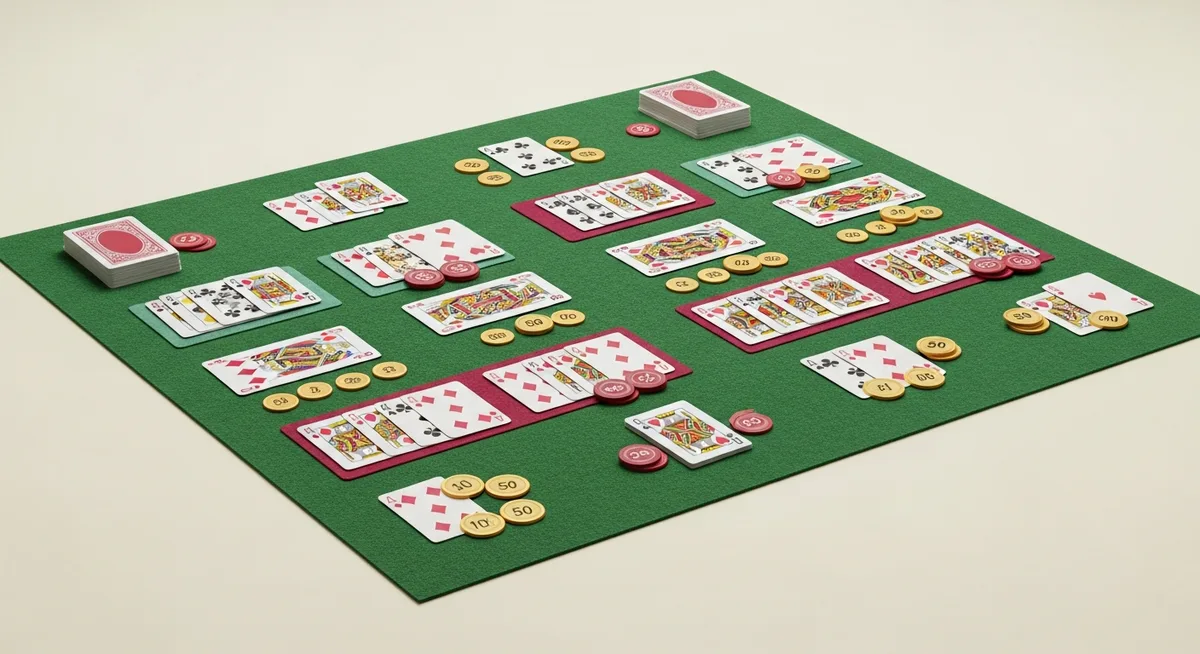
In 13-card Indian rummy, points are penalty points: the player who declares a valid hand first scores zero, and everyone else scores points for the unmatched cards left in their hand. The fewer points you carry, the better. This guide gives the full card-value chart and shows exactly how scoring works across the Points, Pool and Deals formats.
Card values in rummy
Every card carries a point value equal to its rank, with face cards and aces fixed at 10. These points only count against you if those cards are not part of a valid sequence or set when the game ends.
| Card | Point value |
|---|---|
| Ace (A) | 10 points |
| King, Queen, Jack | 10 points each |
| 10, 9, 8, 7, 6, 5, 4, 3, 2 | Face value (e.g. 7 = 7 points) |
| Joker (printed or wild) | 0 points |
How points are counted at the end
When a player makes a valid declaration, every opponent adds up the value of the cards that are not arranged into valid combinations. A valid hand needs at least two sequences, and one of those must be a pure sequence (no joker). If you have not met that rule, more of your cards count against you.
- Cards in a valid sequence or set = 0 points.
- Unmatched (deadwood) cards = their face value, capped per the rule below.
- Declare first with a valid hand = 0 points, the best possible score.
The maximum points you can lose in one game
Most apps cap a single hand at 80 points, even if your unmatched cards add up to more. Two common penalty situations have fixed values:
| Situation | Penalty points |
|---|---|
| First drop (leave before your first turn) | 20 points |
| Middle drop (leave mid-game) | 40 points |
| Wrong declaration | 80 points |
| Maximum for a full hand | 80 points |
Points, Pool and Deals: how scoring differs
The card values never change, but what those points mean depends on the format you choose.
- Points Rummy: each point has a rupee value. The winner collects (total opponent points) × point value. Quick, single-deal games.
- Pool Rummy: points accumulate across deals. Cross 101 or 201 points and you are eliminated; the last player standing wins. 101 Pool is shorter, 201 Pool is longer.
- Deals Rummy: a fixed number of deals; players start with equal chips and the one with the most chips at the end wins.
Example: counting a losing hand
Say an opponent declares and you are left holding K♠, Q♠ (in a valid sequence with J♠), plus 7♦, 4♣ and a 9♥ that form no combination. The J-Q-K sequence scores 0. Your deadwood is 7 + 4 + 9 = 20 points. In a Points game at ₹1 per point, that hand costs you ₹20 to the winner — minus the platform fee the app applies.
If the formats are new to you, our rummy rules for beginners walks through sequences and sets in full, and Yono Rummy vs Yono 777 compares a skill game with a chance-based one.